San Francisco's architectural density presents unique vectors for bed bug dispersion. In neighborhoods like the Mission District, North Beach, and SoMa, shared party walls, hollow lath-and-plaster assemblies, and…
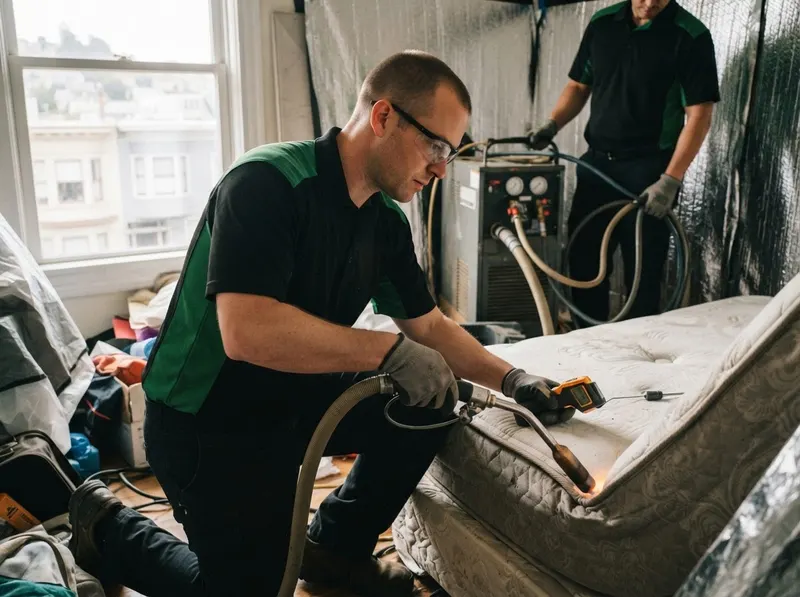
San Francisco's architectural density presents unique vectors for bed bug dispersion. In neighborhoods like the Mission District, North Beach, and SoMa, shared party walls, hollow lath-and-plaster assemblies, and historic subfloor gaps allow Cimex lectularius to travel between adjacent housing units. Traditional chemical sprays often induce behavioral avoidance, causing insects to retreat deeper into structural cavities or migrate along utility runs. Thermal bed bug remediation addresses this structural reality by utilizing convective heat flow, which reaches a verified lethal threshold of 122°F (50°C) across all interior voids. Sensors placed in structural depth points monitor core temperatures to confirm complete mortality across adult, nymphal, and egg stages without saturating living spaces in persistent chemical residues.
Older architectural envelopes in Pacific Heights, Noe Valley, and Bernal Heights require distinct preparation protocols. In Victorian and Edwardian structures featuring 10-foot ceilings and uninsulated exterior bays, heat loss must be mitigated through high-output circulating fans to eliminate cool pockets along baseboards. Conversely, modern multi-unit concrete residential buildings in SoMa and the Marina District mandate strict isolation protocols to prevent heat transfer into adjacent common corridors, ensuring local fire suppression systems and sprinkler heads rated at 155°F remain protected. Kelvex Extermination deploys calibrated sensors throughout the treatment envelope to maintain accurate thermal thresholds between 120°F and 140°F, protecting sensitive finishes while achieving structural eradication.
Decision guidance hinges on structural history and infestation duration. For active infestations spanning multiple rooms or properties with deep plaster trim, thermal remediation provides a definitive single-visit solution where multi-cycle insecticide treatments frequently fail due to insecticide resistance. The trade-off involves preparatory steps: occupants must temporarily remove heat-sensitive items, including aerosol cans, candles, wax items, oil paintings, prescription medications, and specific consumer electronics. Structural heat treatment satisfies San Francisco Department of Public Health habitability mandates swiftly, pre-empting the prolonged administrative disputes common in tenant-occupied multi-family flats throughout Richmond District and Sunset District.
Every job gets a firm, written price after a free on-site visit.
Tell us about your thermal bed bug remediation job in San Francisco and we'll send a clear, written quote, usually the same day.
 Kelvex Extermination