Argentine ants (Linepithema humile) do not behave like native ant species because single supercolonies contain hundreds of fertile queens and millions of workers across entire city blocks. In high-density San Francisco…
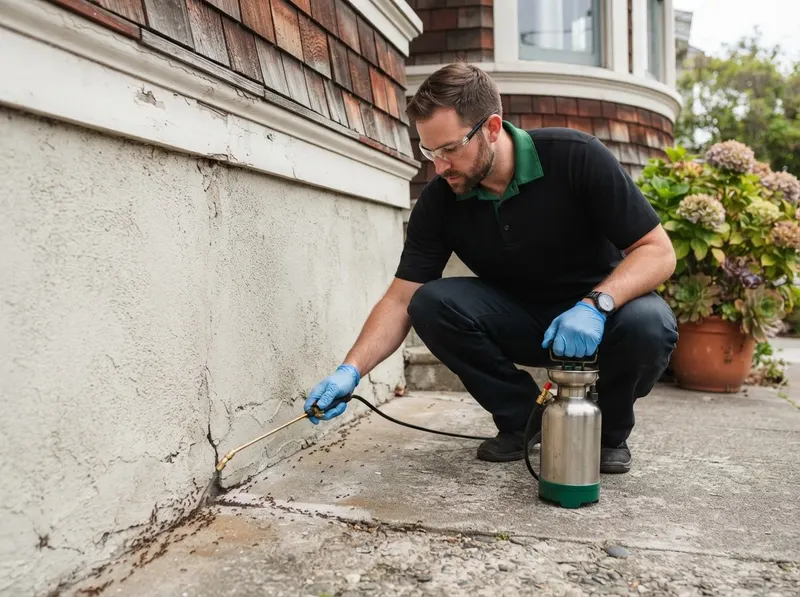
Argentine ants (Linepithema humile) do not behave like native ant species because single supercolonies contain hundreds of fertile queens and millions of workers across entire city blocks. In high-density San Francisco housing, including connected Victorian and Edwardian flats in the Mission District, Pacific Heights, and Noe Valley, over-the-counter repellant sprays trigger budding. Budding is a survival mechanism where surviving queens fracture from the colony and disperse into sub-wall voids, converting a single kitchen problem into a five-room infestation within 48 hours. Successful eradication requires slow-acting horizontal transfer, where forager ants ingest non-repellent bait compounds and carry the active ingredient back to feed multiple reproductive queens.
Microclimates in San Francisco directly drive seasonal ant incursions into interior spaces. In the coastal fog belts of the Sunset District and Richmond District, sustained ocean moisture forces colonies into raised ground-level subfloors and crawlspaces. Conversely, warm dry spells in SoMa and the Marina District drive ants inward toward interior plumbing runs, radiator lines, and under-sink pipe penetrations. Concrete foundations common to Bernal Heights and North Beach row houses often harbor subterranean trail networks beneath shared masonry walls. Kelvex Extermination bypasses surface treatments, deploying sealed bait stations with sweet and protein bait matrices matched to the seasonal reproductive lifecycle of the queens.
Architectural mitigation forms the permanent defense layer once the biological colony collapse is initiated. Standard pest services stop after applying exterior sprays, but lasting control in attached San Francisco architecture requires sealing the building envelope. Technicians locate specific ingress voids, such as utility penetrations, cracked mortar lines, foundation weep holes, and window casing gaps, and seal them using silicone-based bio-barriers and copper mesh. This dual approach ensures existing colonies collapse from reproductive failure while new foraging scouts from adjacent properties cannot establish replacement nests inside wall cavities.
Every job gets a firm, written price after a free on-site visit.
Tell us about your argentine ant colony eradication job in San Francisco and we'll send a clear, written quote, usually the same day.
 Kelvex Extermination